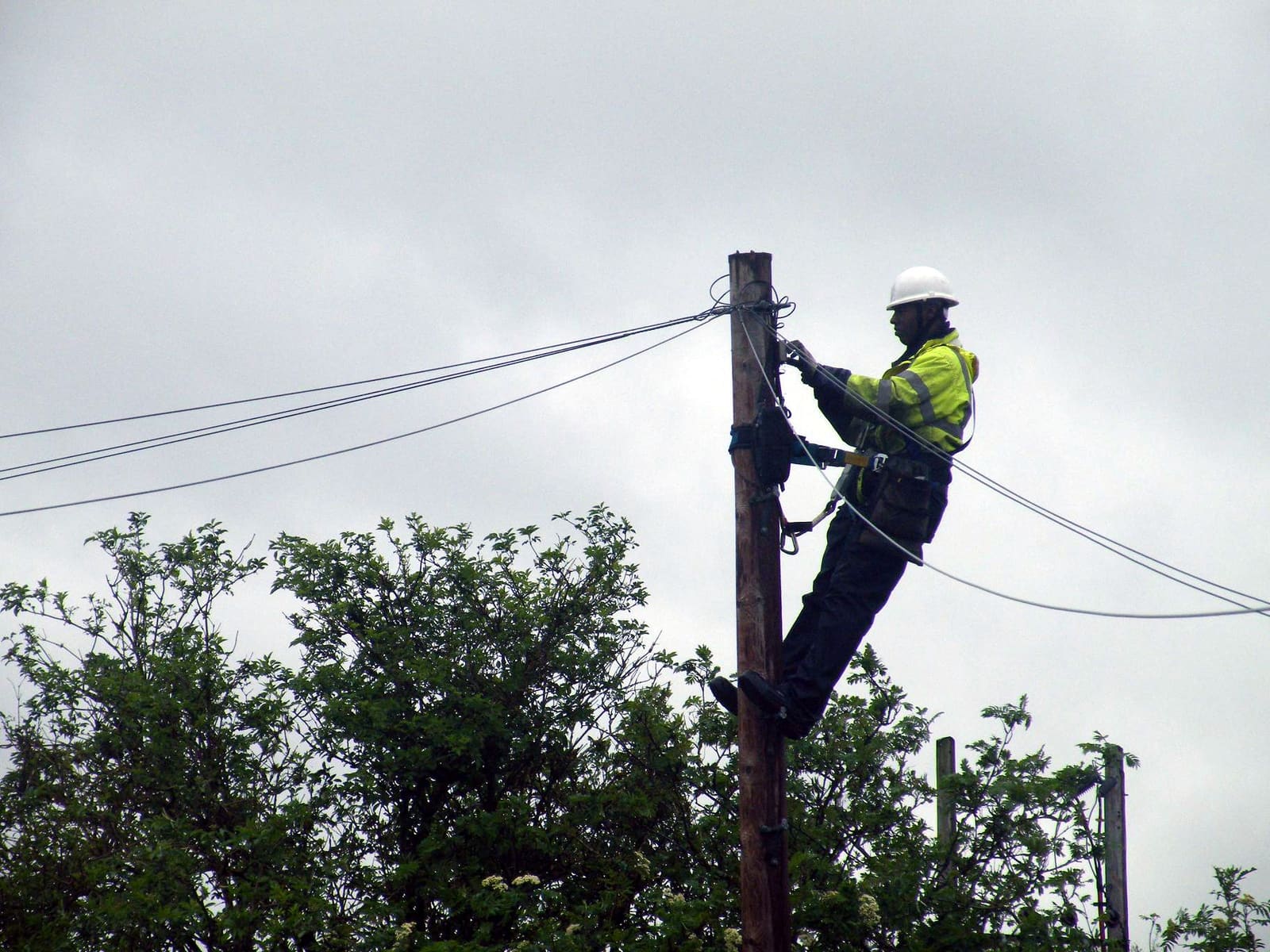
For anyone who works from home, broadband is infrastructure as fundamental as the boiler — and unlike the boiler, you cannot replace it if the street was never cabled. Connectivity varies house by house, not just town by town: one side of a road can have full fibre while the other waits years, and a thick-walled stone cottage can kill a mobile signal that is perfect at the gate.
Every check in this guide is free and takes minutes. Do them before you offer, because the answer is occasionally a dealbreaker and always a negotiating fact.
The technologies, in plain English
Adverts blur everything into "fibre", so it pays to know what is actually reaching the house:
- ADSL — broadband over the old copper phone line all the way from the exchange. Often 5–10 Mbps. Now legacy, and being phased out with the copper network.
- FTTC ("fibre to the cabinet") — fibre to a green street cabinet, copper for the final stretch. Sold as "fibre", advertised "up to" 80 Mbps, but real speed falls off quickly with distance from the cabinet: a long line might manage 25 Mbps.
- Cable (Virgin Media's network) — coaxial cable capable of gigabit downloads, though upload speeds are typically much lower than fibre.
- FTTP ("full fibre") — fibre all the way into the home. Gigabit-plus down, strong uploads, and the most reliable of the lot. This is the one worth the name.
Check the exact address, not the postcode
Ofcom's official broadband and mobile checker reports availability for a specific address: which technologies are available, predicted speed ranges, and outdoor/indoor mobile coverage predictions for all four networks. Because availability differs between neighbouring houses, always search the full address rather than the postcode.
Cross-check with providers' own address checkers (Openreach's for the BT-based networks, Virgin Media's for cable, plus any "altnet" full-fibre builders active locally). Where full fibre is not yet available, Openreach publishes its rollout plan by exchange — useful, but treat build dates as aspirations, not promises, and never buy a house on the strength of a rollout that has not physically happened.
One deadline worth knowing: the old analogue landline network is being switched off, with the migration to digital voice services due to complete around January 2027. That matters mainly for homes still on ADSL and for anyone relying on a corded phone or telecare alarm — another nudge towards checking what modern connectivity the address can actually get.
Sources: Ofcom — broadband and mobile checker · Openreach — fibre rollout checker · Ofcom — Connected Nations coverage reports
What "up to" actually means
Under UK advertising rules, a broadband speed advertised as "up to 67 Mbps" must be available to at least 50% of customers at peak time — which means it is perfectly legitimate for the other half to get less, sometimes much less. For FTTC in particular, your speed is largely set by the length and quality of the copper between the cabinet and the house, which no provider or tariff can change.
When a provider quotes for a specific address, consumer protections are stronger: signatories to Ofcom's speed codes must give a personalised speed estimate before you sign and let you exit the contract without penalty if speeds persistently fall below the guaranteed minimum. So the number that matters is the address-level estimate, not the advertised headline.
How much speed do you actually need?
Honest requirements are lower than adverts imply — but upload and stability matter more than the headline download figure. A video call needs only around 2–4 Mbps each way, but it needs them consistently, and several simultaneous calls plus cloud backups compound quickly.
- One person, email and browsing: almost anything works, 10+ Mbps.
- Streaming household, one home-worker: 30–50 Mbps down, 10 Mbps up, comfortably.
- Two home-workers on video calls, cloud storage, kids streaming: 100+ Mbps down and — the bit FTTC cannot do — 20+ Mbps up.
- Large file transfers, video production, serious backups: full fibre, for the upload speed as much as the download.
- There is a legal floor: under the Universal Service Obligation, homes that cannot get a decent connection (10 Mbps down / 1 Mbps up) can request one, though the mechanism is slow and cost-capped.
Mobile signal: test it inside the house
Coverage maps are modelled predictions for outdoors; your calls happen indoors, behind whatever the walls are made of. Stone, brick, foil-backed insulation and low-E glazing all attenuate signal, which is why a house can show "good" coverage on every map and still have a kitchen where calls drop.
The reliable test costs nothing: at the viewing, walk every room you would work or sleep in with your own phone, check bars and run a quick speed test, and ask the other adults in your household to do the same on their networks. If the house fails, WiFi calling and 4G/5G indoor units are decent mitigations — but check they suit your networks before relying on them.
Where broadband fits in the household budget
Connectivity is a running cost like any other: a solid full-fibre package typically runs £25–£45 a month, with mid-contract price rises now (since 2025 rule changes) required to be stated in pounds and pence up front. When you compare two homes, compare their whole monthly cost of occupation — energy, council tax, connectivity — rather than price alone; a cheaper house that needs a 4G fallback and a booster is not as cheap as it looks.
Sketch the rest of the bills picture for any home you are weighing up:
Illustrative only: energy figures are band-typical for an average 3-bed and swing with usage and prices; council tax uses the England Band D average (~£2,392 for 2026/27) scaled by the statutory ninths — your council will differ. Excludes water, broadband, insurance and maintenance.